
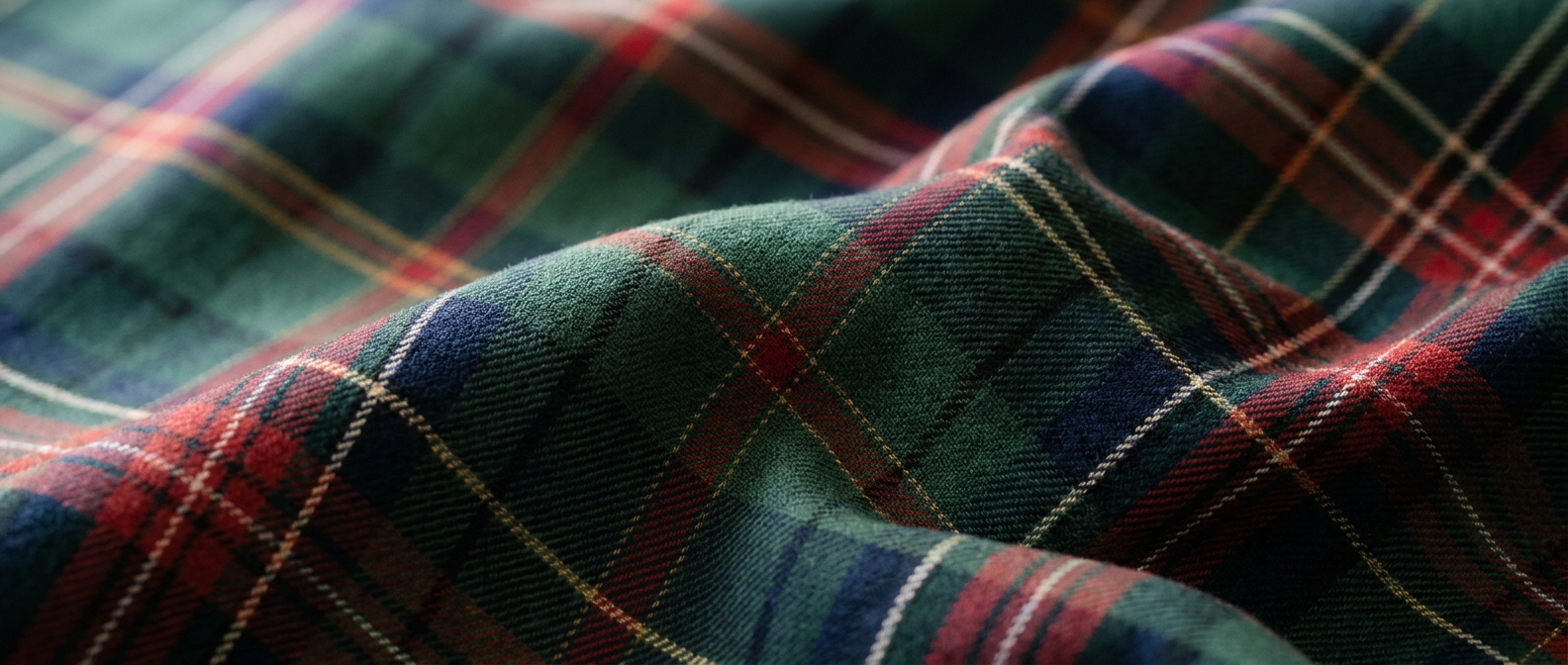
From stripes to a tartan pattern
In woven cloth, the long vertical yarns are the warp and the horizontal yarns crossing them are the weft. A tartan normally repeats the same colour sequence and stripe widths in both directions.
Where a red warp stripe meets a red weft stripe, the eye sees a solid red block. Where red crosses blue, both yarn colours remain visible and create a mixed area. The Scottish Register of Tartans calls this a half-tone. Traditional 2/2 twill makes those mixed areas look diagonally hatched.
The full repeat — from one point in the sequence until the design begins again — is the sett.
The threadcount is the recipe
A weaver needs more than a picture. The threadcount records each colour and the number of threads used before the next colour begins. The Register describes it as the DNA of a tartan.
A simplified sequence might look like this:
B24 W4 B24 R2 K24 G24 W2
The letters are colour codes and the numbers are quantities of threads. This example begins with 24 blue threads, then four white, and continues in the stated order. It allows the stripe proportions to be recreated consistently.
Most setts are symmetrical or reflective. Their sequence turns at pivot points and mirrors back on itself. An asymmetrical sett does not mirror; it reaches the end of its sequence and begins again. The Register uses different notation for the two so a weaver knows how the repeat behaves.
Does the size of the sett matter?
The design and its physical scale are related but not identical. The same threadcount proportions can be woven or printed at different sizes. A small repeat can suit a tie or compact accessory, while a kilt needs enough scale for the pattern and pleats to read properly.
The Register's guidance suggests that a two-to-three-inch sett may suit a tie, whereas a six-to-seven-inch sett is more appropriate for a kilt or skirt. When a tartan moves onto a tea towel, scarf or other printed object, the scale should be chosen deliberately so the pattern is legible and does not feel like an accidental crop.
Ancient, modern and weathered colours
Terms such as ancient, modern, weathered and muted usually describe colour palettes rather than the age of the tartan itself. “Ancient” does not prove that a particular piece of cloth is old, and “modern” does not mean the underlying pattern was recently designed.
In many commercial ranges, the stripe sequence stays recognisably related while the shades change: modern colours may be deeper and stronger; ancient palettes lighter; weathered palettes earthier. Conventions vary between mills and manufacturers, so compare the actual cloth or product rather than relying on the label alone.
Is every check a tartan?
The statutory definition used by the Scottish Register describes tartan as a design capable of being woven, made from two or more alternating coloured stripes combining vertically and horizontally into a repeated chequered pattern.
The Register also distinguishes very simple checks from more developed tartan designs. Its guidance describes a check as a simple form with small regular colour blocks and without the overchecks, bands and varied stripes found in many tartans.
What printing changes — and what it does not
When a sett is printed, no coloured warp and weft cross to create it physically. The repeat, stripe order and half-tones are represented in the artwork and applied to a base cloth. That changes the construction, but careful artwork can preserve the geometry and proportions of the design.
This is why a high-resolution source and controlled scaling matter. A blurred line, altered proportion or careless crop can change the character of a sett even when the colour names sound correct.
Read our full guide to printed and woven tartan or see the clan and universal setts in our planned collection.