
The short answer
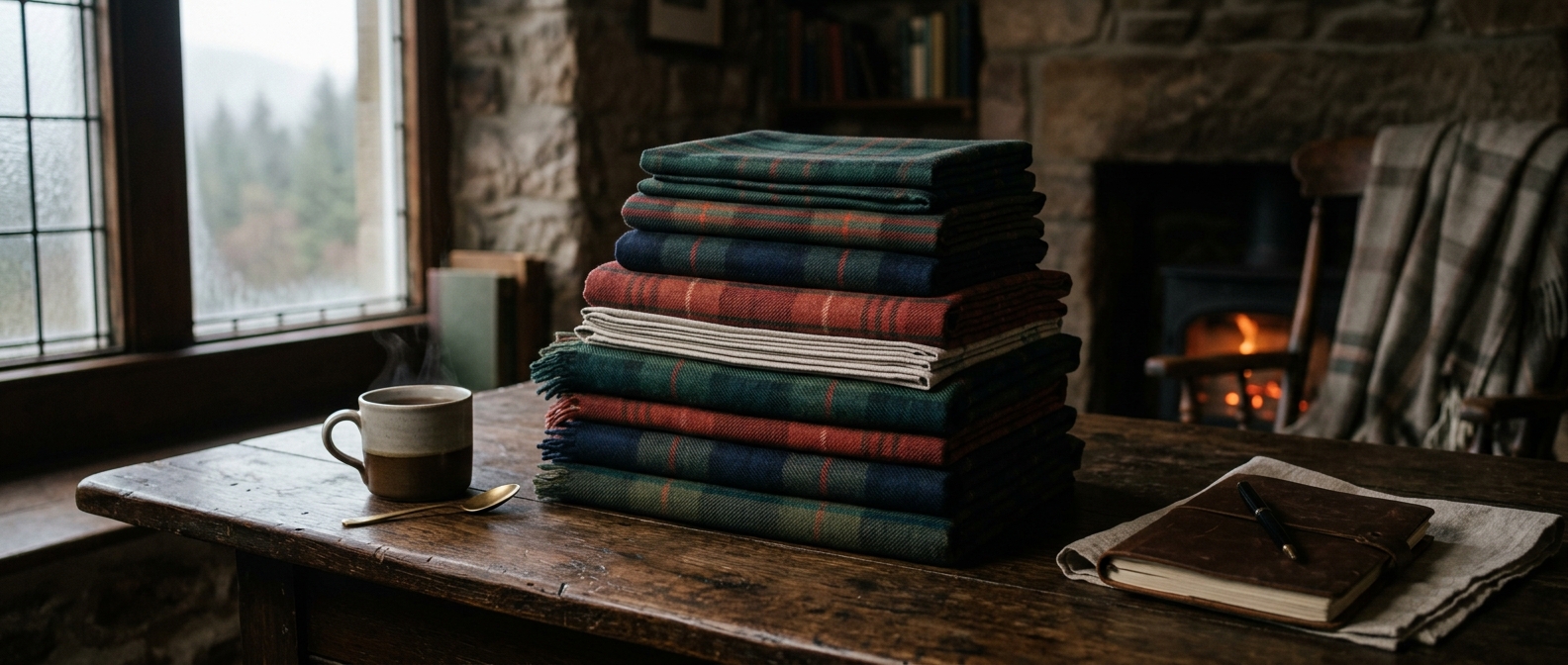
In woven tartan, the vertical warp and horizontal weft are arranged in the same sequence of coloured stripes. The crossings create the familiar grid and its mixed-colour areas. The Scottish Register of Tartans notes that traditional tartans are usually woven in a 2/2 twill, which gives the cloth its characteristic diagonal, hatched appearance.
Printed tartan begins with cloth that has already been woven or knitted. The sett is then placed on its surface using a textile printing process. Modern digital printing can reproduce fine lines and many colours without setting up a separate loom for every pattern.
The distinction is not “real” against “fake”. It is pattern made through construction versus pattern applied to a base fabric.
How woven tartan behaves
Because the coloured yarns form the cloth itself, a woven tartan normally shows its pattern on both faces. The structure of the weave gives it physical depth: where different coloured yarns cross, the eye sees a blended shade known as a half-tone.
The fibre, yarn and cloth weight still matter. A light wool tartan for a tie will behave differently from a heavier kilt cloth, even when both use the same sett. Woven tartan is particularly natural for garments and objects where drape, pleating, warmth or a patterned reverse are important.
Setting up a loom takes work, especially for a short run or an uncommon sett. That is part of the value of woven cloth, but it can also limit the number of designs or product formats that make sense in a small collection.
How printed tartan behaves
With printing, the chosen base cloth determines much of the finished product's character. Cotton, linen, polyester and silk do not suddenly acquire the same handle because the same tartan is printed on them. Weight, softness, sheen, wash performance and colour response all depend on the fibre, construction, inks and finishing process.
The reverse will usually be paler or different from the printed face, although the degree varies by process and base cloth. The visual crossing of warp and weft is reproduced in the artwork rather than created by differently coloured yarns meeting in the weave.
Printing is flexible. A maker can use a lightweight or smooth fabric, adjust the scale of a sett for a smaller object, and produce shorter runs without preparing a dedicated yarn-dyed warp. That makes it useful for accessories, linings, homeware and other pieces where a traditional kilt-weight wool would be impractical.
What changes when a tartan is printed on silk?
Silk describes the fibre, not the printing method. A silk scarf might be digitally printed, screen printed or produced by another textile process. The result depends on the type and weight of silk, the ink chemistry, colour management and finishing.
That is why broad claims about “silk printing” are rarely useful on their own. The better questions are: which silk, which process, how does the reverse look, how should it be cared for, and has the finished product been tested? We will answer those questions for any silk product we release rather than treating the fibre name as a guarantee of quality.
Is printed tartan less authentic?
A printed fabric is not the same object as a traditionally woven tartan, and it should not be described as one. Honest labelling matters. But the design can still be treated accurately: the stripe order, proportions and colours can be reproduced with care, and the product can state plainly that it is printed.
For The Tartan Bureau, print is a way to place tartan on useful, contemporary objects while keeping the pattern clear and the range accessible. It does not replace Scottish weaving. A future woven collection would serve a different purpose and deserve its own material story.
Which should you choose?
Choose woven tartan when the construction is central to the object: a kilt, tailored garment, heirloom blanket or piece where both faces, woollen handle and woven depth matter.
Choose printed tartan when the base cloth or product format calls for it: a light accessory, detailed surface, short run or everyday object that would not suit traditional wool.
The best choice is the method that fits the product and is described honestly. Look beyond the word tartan and ask what the cloth is made from, how the pattern was created, how it feels and how it should be used.
Next, learn how the sett defines the pattern or browse the tartans planned for our first collection.